
A website project rarely goes over budget because of one big surprise. It usually expands through small, unclear decisions: an extra page here, a new payment rule there, a late request for account areas, product filters, or CRM data. Fixed price web development is designed to stop that drift before it starts.
For a startup, service business, or growing online retailer, a fixed fee is not just easier for accounting. It creates a practical operating plan. You know what is being built, what it costs, who provides what, and what has to happen before launch. That makes it easier to plan campaigns, stock, staff training, and cash flow around the website instead of waiting for an open-ended project to finish.
What Fixed Price Web Development Actually Means
A fixed-price project has a defined scope, a stated delivery process, and an agreed fee. The development team does not bill more hours simply because the work takes longer than expected. In return, both sides need to be precise about the result.
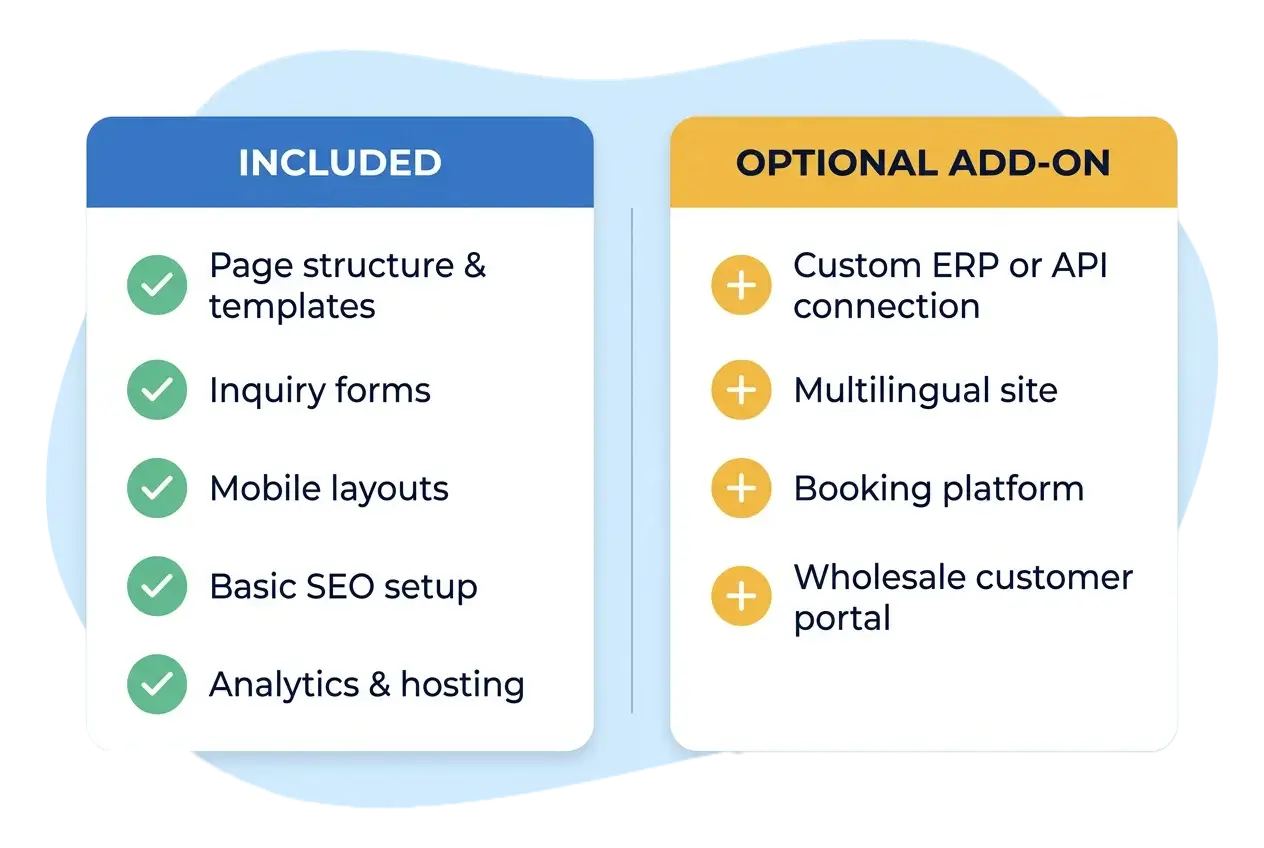
That result should be more useful than a line item such as “five-page website” or “WooCommerce setup.” A workable scope explains the commercial job of the site and the implementation behind it. For a service company, that may include page structure, inquiry forms, conversion paths, mobile layouts, basic SEO setup, analytics, hosting configuration, and a launch checklist. For an online store, it may also cover product imports, payment gateways, shipping rules, customer accounts, transactional emails, tax settings, and order-management workflows.
The fee should also distinguish between included work and optional work. A payment gateway integration may be included. A custom connection to an unusual ERP platform may require a separately scoped add-on. That is not a weakness in the pricing model. It is how a fixed project remains honest.
Why Predictable Pricing Matters to Growing Businesses
Most small businesses do not need an unlimited menu of development hours. They need a website that performs a defined job: generate qualified inquiries, establish credibility, sell products around the clock, or reduce manual administration.
Fixed pricing aligns the project with that goal. It changes the conversation from “How many hours will this take?” to “What needs to be in place for this business outcome?” You can compare packages by practical components: pages, product capacity, payment methods, performance work, content migration, integrations, and support after launch. If you are still working out what a realistic budget looks like, our breakdown of what a professional WordPress website actually costs sets the baseline ranges.
It also makes approvals faster. A founder can decide whether the Growth-level package includes enough to launch now, or whether the Pro-level scope is justified because the store needs advanced filters, API connections, multiple payment methods, or a more complex catalog. There is less ambiguity for the person approving the budget.
For established businesses, predictable pricing protects operational planning. If the new site is tied to a seasonal sale, new location, product release, or change in internal systems, the project needs a controlled timeline. A clear scope makes it possible to identify dependencies early, including access to domain settings, product data, payment-provider accounts, brand assets, and legal pages.
A Fixed Fee Does Not Mean a Generic Website
There is a common concern that fixed price web development produces a template with a new logo added to it. That can happen when the scope is shallow. It does not have to happen when the package is built around clear business requirements.
A structured project can still include custom visual direction, a conversion-focused content hierarchy, tailored WooCommerce settings, and technical configuration specific to the business. The difference is that the customization is planned rather than invented during every weekly call.
For example, a local service company may need a homepage designed around one primary inquiry action, service pages that answer buying questions, location coverage, trust signals, and a form that routes leads to the right team member. An online retailer may need category navigation, product variations, card and wallet payments, delivery logic, abandoned-cart emails, and stock processes that staff can manage without calling a developer.
Neither project needs vague, unlimited experimentation. Both need the right decisions made early and implemented properly.
The Scope Details That Prevent Expensive Surprises
A credible fixed-price proposal should state what the client receives, but the exclusions matter just as much. Before work begins, confirm the number of pages or templates, content responsibilities, revision process, supported browsers, and launch criteria.
Scope questions to settle before an online store is quoted
For e-commerce, ask direct operational questions before anyone quotes a number:
- How many products need to be added or migrated?
- Are products simple, variable, bundled, or subscription-based?
- Which countries will you sell to?
- Do shipping rates change by shipping zone, order value, or product size?
- Is an existing inventory, accounting, CRM, or fulfillment system involved?
Each answer changes the build. We cover the full delivery list in more detail in what a WooCommerce developer should deliver.
Technical requirements need the same clarity. “Fast website” is too broad on its own. A stronger scope may include image optimization, caching, Cloudflare configuration, database cleanup, Core Web Vitals checks, and Lighthouse testing. “Secure hosting” should define backups, SSL, updates, monitoring, and the response process if something fails.
Content is another frequent source of delay. If product descriptions, photography, company copy, legal policies, or credentials arrive late, a launch date can move even when development is complete. A fixed plan should set deadlines for client inputs and explain what happens if they are not available.
How Changes Work Without Breaking the Budget
A fixed-price agreement should not trap a business in a bad decision. Requirements sometimes change because the business learns something during the project. The question is whether the change is a refinement of the agreed scope or a new requirement.
What counts as a revision in fixed price web development
Changing the wording or layout of an approved service page is usually a normal revision. Adding a booking platform, a multilingual site, a wholesale customer portal, or a custom API connection is a different level of work. Those additions should be priced separately, with their own deliverables and timeline impact.
This approach is better for both sides. The client sees the cost before approving the change. The development team can assess the technical risk rather than squeezing extra work into the original delivery window. It prevents the frustrating situation where a project appears inexpensive at the start but becomes slow, rushed, and difficult to support later.
A phased payment structure supports this discipline. Commonly, an initial payment reserves the project and covers planning, a second payment follows design or build approval, and the final payment is tied to testing and launch. The exact split can vary, but every stage should have a visible output.
Choosing the Right Package Before You Build
Match the package to the bottleneck, not the feature list
The best package is not the one with the longest feature list. It is the one that removes the current bottleneck without paying for complexity the business will not use.
A Starter-level website can be the right answer when the immediate problem is credibility. If prospects search for the company, visit the site, and cannot quickly understand the offer or make contact, a focused business website with clear calls to action, mobile performance, and SEO-ready foundations can change that.
A Growth-level scope makes sense when lead generation depends on more content, stronger conversion paths, service segmentation, migration from an old site, or better technical infrastructure. It gives a business room to compete without moving into unnecessary custom development.
A Pro-level e-commerce build is appropriate when the website is becoming an operational sales channel. That often means WooCommerce configuration, product and category structure, payments, customer accounts, shipping logic, order notifications, performance optimization, and the systems needed to manage sales day after day. King Web packages this type of work so the commercial scope and technical setup can be reviewed before build work begins.
The decision depends on where revenue is being lost. A retailer with a working product catalog but abandoned carts may need checkout and performance improvements, not a full redesign. A service company with strong referrals but weak search visibility may need strategic pages and technical SEO foundations first. Fixed price web development works best when it addresses the actual constraint.
Questions to Ask Before Signing Off
Before selecting a provider, ask what is included in the launch, what the client must supply, and how changes are handled. We go deeper on this in questions to ask before hiring a web developer. At minimum, confirm who configures:
- Hosting and domains
- Backups
- Email delivery
- Analytics
- Cookie consent
- Payment accounts
These details often sit outside visual design, yet they determine whether the website can operate reliably after the launch date.
You should also ask how quality is checked. A professional process includes responsive testing, form testing, checkout testing for stores, performance checks, basic security configuration, redirects where required, and a final review against the agreed scope. If a provider cannot describe the acceptance process, the fixed price may be fixed only on paper.
Finally, clarify what happens after launch. Websites need updates, monitoring, backups, and occasional improvements. Ongoing maintenance should be available as a separate, understandable service, not presented as an unexpected dependency once the site is live — we set out what responsible support looks like after launch day.
A clear fixed price web development project gives your business more than a number on a proposal. It gives your team a controlled path from an outdated or disconnected web presence to a site that can capture leads, process orders, and support the next stage of growth.